
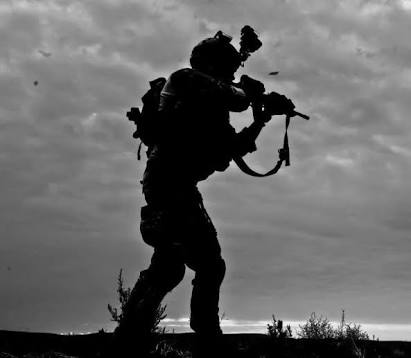
"In war, there are no unwounded soldiers"
I once saw this words in a quote by a man named José Narosky.
As I looked at the men and women arrayed around me - most of them already fidgeting from waiting for my speech for so long, nervous excitement from wanting to celebrate what was undoubtedly a big victory - I was struck by just how true the sentiment was.
Squinting a little, to help my eyes adjust to the dim lighting we had available in the makeshift mess hall of our barracks, I could see every one of my troops from my makeshift podium of sandbags. With a cement filled barrel in front of me acting as my pulpit, I almost felt like some sort of preacher. Unfortunately, I did not have any good news for them.
I looked at each of them, trying not to skip over any one. I could see the scars and tells of what had been a long war on them. The scars weren't just physical even. I could see in their eyes that my soldiers' souls and spirits had been forever changed by the long campaign.
I was naturally not an Armchair General, I preferred to be out in the field experiencing the adrenalin of a raging battle, but a greivious injury to my right side during one of our expeditions with less than happy memories had confined me to my command chair while my troops went out.
I never liked the politicians who, with their silver tongues, sent soldiers out to war without every counting what it would cost the man. Meanwhile, these same politicians sat back at home gorging themselves fat on the resources of the motherland. When we returned from the wars they had sent us on, we were welcomed back with open arms, warm smiles and empty promises. Left to fend for ourselves in the land we had left to defend. A land which we were now strangers to.
So, I made sure to commit every injury and every scar, every bruise and every hole that my men suffered while in the field on my orders.
It was perhaps slightly masochistic, but also cartharic. I knew that for every blow they recieved, my troops dealt out twice as much damage.
I completed my survey of the room and took a deep breath. At once, they all fell silent, their attention completely on me.
Long ago, when I just joined the force, my first commanding officer took me under his wing and taught me a great deal. One of his lessons I took to heart the most was about battlefield voices.
He said that a commander must have a voice capable of reaching his troops even through the din and chaos of a battlefield. Not necessarily because of how loud it was, but because of the authority it carried.
I used it here as I delivered a speech my tired soldiers would not want to hear. Here were people, my people, who had given everything they had to the cause, and I was about to tell them that it wasn't enough, that they had to give more.
"My brothers-in-arms, we are..."
I faltered, clearing my throat, I tried again.
"We have all made sacrifices, great and small, for the advancement of our people. We have fought, we have bled, we have killed and some of us are dead."
A pause, not only for dramatic effect, but also to collect my thoughts.
"We have given up much to ensure the prosperity of our people. We have fought The Enemy, driven him back, watched him bleed."
Another pause, this time, more for effect than anything else.
"We have suffered great losses, but our goal, our reward has always been the safety and prosperity of future generations. With your valient efforts, this reward is closer than ever!"
They do not break out into cheers - of course not, they are soldiers - but, from the subtle reactions every commander watches for in his troops, I can tell that my words have had an impact.
It's almost funny, in a tragic sort of way, that with each of these speeches I give, I feel myself becoming more and more like the politicians I so despise.
I know what my men want to hear. I can see the longing in their eyes, the tiredness in their bones. They want to hear me say that the war is over, that they can finally let their guards down.
I wished I could be the preacher, bringing them good news from my makeshift pulpit, but I also had to be a General.
"We have won an important victory here, but the war continues. Nevertheless, the end is now in sight, just over the horizon. We must rally ourselves for one last glorious push. For the Motherland!"
This time, they do erupt in cheers.
As I dismount the podium, I allow myself to feel a small sense of satisfaction. I have not lied to my men but I have, at least for the night, pacified their weary souls.
The end of the war is in sight, just beyond the horizon. The only problem is, just like a sunset, you can never really get there.
The closer you walk to the sunset, the more it distances itself from you.
I retreat to my quarters and I am reminded of another quote.
"Love is like war: easy to begin but very hard to stop."
And with that, my thoughts wander to the woman I love.
Keep the conversation going.
Sign in to add your perspective.